
Network segmentation is the deliberate creation and enforcement of trust boundaries within infrastructure. It is not simply the act of assigning systems to different VLANs.
A VLAN can separate broadcast domains and tell us where a system lives. Effective segmentation determines what that system is allowed to reach, through which path, using which services, and for what operational reason.
That distinction matters because infrastructure should be designed with a realistic assumption: eventually, something will go wrong. A workstation may be compromised. An IoT device may behave unexpectedly. A vendor appliance may contain a vulnerability. A configuration error may expose a service that was never intended to be broadly reachable. The architectural question is what happens next.
The architectural questionIf this system is compromised, what can it reach next?
Flat networks are easy to build
Flat networks are rarely the product of careless administration. They often begin as a reasonable response to a smaller environment: simple to deploy, easy to understand, fast to expand, and light on routing or firewall policy.
The problem emerges gradually. New users, servers, wireless systems, operational devices, vendors, and remote-access requirements are added faster than the architecture is reconsidered. Convenience becomes implicit trust. Systems can communicate because they are internal, not because the communication is understood or required.
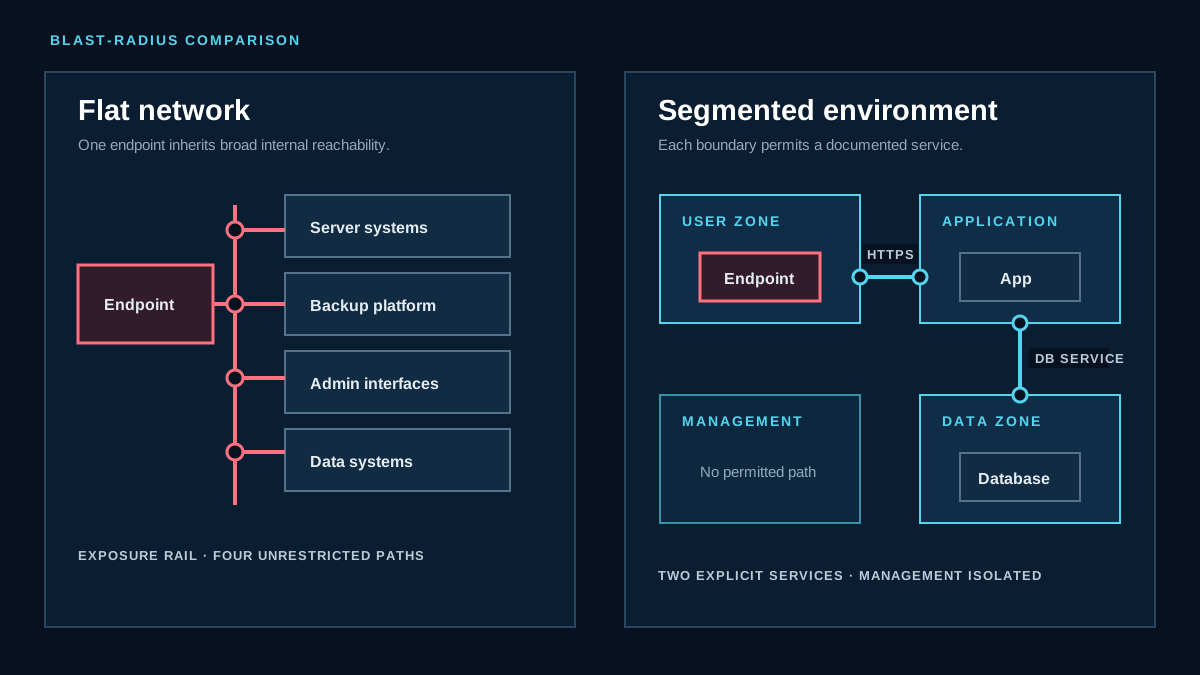
At that point, one compromised endpoint may be able to discover and reach systems that have no operational relationship to it. A local incident inherits the reachability of the network around it.
Segmentation is not the same as creating VLANs
VLANs are useful building blocks. They create Layer 2 separation, reduce broadcast scope, and provide a practical way to place systems into distinct network domains. None of that automatically defines trust.
A network can contain many VLANs and still be poorly segmented. If inter-VLAN routing is broadly permitted, or if an upstream firewall contains permissive rules between every internal zone, the labels have changed while effective reachability has not.
Segmentation begins when crossing a boundary requires an explicit policy decision. The engineering focus shifts from subnets and VLAN IDs to allowed relationships between systems.
A VLAN tells you where a system lives. Segmentation should determine what that system is allowed to reach.
Start with systems and trust boundaries
Good segmentation starts with operational context rather than a universal VLAN template. Users, applications, servers, voice, guest access, IoT, backup, vendor systems, management services, and infrastructure may deserve different treatment—but the labels alone do not define the architecture.
The useful work is understanding each system: what it does, what it genuinely needs to communicate with, who administers it, how sensitive it is, and what would happen if it became compromised or unavailable.
Those answers reveal trust boundaries. They also prevent a common design failure: building tidy-looking zones that do not reflect actual application flows, administrative responsibilities, or recovery dependencies.
What does this system do?
What does it actually need to communicate with?
Who administers it?
How sensitive or operationally important is it?
What happens if it becomes compromised?

Control communication between zones
Traffic crossing a trust boundary should have an operational reason. A useful policy model is SOURCE → DESTINATION → REQUIRED SERVICE.
A user workstation may need HTTPS access to an application. The application may need a specific database service. That does not mean the user network requires direct access to the database, or that the application tier requires unrestricted access to every server.
Layer 3 boundaries, firewall policy, ACLs, service restrictions, and logging can enforce these relationships. The mechanism matters less than the resulting behavior: least-required connectivity, predictable paths, and enough visibility to understand boundary traffic.
Protect the infrastructure that controls the infrastructure
The management plane deserves particular attention because it controls the systems that enforce every other boundary. Firewalls, switches, wireless controllers, hypervisors, storage platforms, backup systems, UPS interfaces, server-management controllers, and monitoring platforms should not be treated like ordinary user-facing services.
A compromised employee workstation should not automatically provide a convenient path to the administrative interface of a firewall, hypervisor, or backup platform. Administrative access should originate from controlled systems, use deliberate paths, and be restricted to the people and services that require it.
This is more than a cybersecurity measure. Protecting management access also reduces accidental changes, makes administrative activity easier to observe, and gives responders a more trustworthy control plane during an incident.
Design to contain compromise
Segmentation does not guarantee that endpoints will never be compromised. Its value is visible in what the architecture permits after compromise.
If malware reaches one workstation, the relevant questions are concrete: what can it discover, what can it communicate with, what can it attack next, and can it reach administrative infrastructure or unrelated operational systems?
A well-enforced boundary reduces lateral movement. It turns an environment-wide problem into a smaller investigation, limits the number of systems exposed to the same path, and preserves unaffected areas while response work proceeds. That is blast-radius reduction in operational terms.
- Limit unnecessary discovery and reachability beyond the local trust zone
- Deny unnecessary east-west communication
- Protect administrative interfaces and backup systems
- Log meaningful boundary crossings
- Preserve unrelated services during containment and recovery
Segmentation improves operations too
Security is only one dimension. Meaningful boundaries also improve visibility, troubleshooting, fault containment, change management, and documentation.
When traffic crosses defined enforcement points, teams can observe and log important dependencies. Troubleshooting becomes more deterministic because communication paths are explicit. Changes can be evaluated against known flows rather than broad assumptions about internal reachability.
Segmentation also helps contain operational faults. A broadcast issue, misconfigured service, or unstable device in one area is less capable of affecting unrelated infrastructure. Documentation can describe functional roles and approved dependencies instead of merely listing IP ranges.
Security
Restrict unnecessary access and lateral movement.
Resilience
Contain compromise and operational failure within meaningful boundaries.
Operational control
Make communication paths understandable, observable, and supportable.
The vessel environment
A vessel is a practical example of why shared physical infrastructure should not imply shared trust. Passenger connectivity, crew services, management systems, vendor equipment, shipboard infrastructure, and IT administration may coexist within a compact environment while serving very different operational purposes.
Passenger connectivity should not inherently share trust with shipboard infrastructure. Vendor equipment may require a narrow path to a specific service without access to unrelated networks. Crew endpoints should not automatically reach infrastructure administration. Management systems may require controlled shore-side communication while remaining isolated from passenger environments.
IT personnel still need workable administrative access, including remote support when appropriate. The goal is not isolation for its own sake; it is controlled connectivity designed around the vessel’s operating profile, dependencies, and consequences of failure.

Segmented on paper
Some environments look segmented in diagrams but remain broadly trusted in operation. Multiple VLANs may exist while permissive inter-VLAN routing allows almost any system to reach any other system.
Temporary exceptions become permanent. Vendor systems receive more access than their function requires. Management interfaces remain reachable from user networks. Legacy dependencies prevent enforcement, but the dependency is never documented or addressed.
The most difficult environments often contain firewall rules nobody fully understands and administrators are afraid to remove because nobody knows what will break. That is not merely a policy-cleanup problem; it is a visibility and architecture problem.
Warning signs
- Multiple VLANs with permissive inter-VLAN routing
- Broad ANY → ANY policies
- Temporary exceptions without owners or expiry
- Management interfaces reachable from user networks
- Vendor access extending beyond the required service
- Legacy dependencies that are neither documented nor contained
- Rules retained because their purpose and impact are unknown
What good segmentation looks like
A well-segmented environment is not defined by a product or an arbitrary number of zones. It is defined by intent that remains visible in the architecture and enforceable in operation.
Systems are grouped for operational reasons. Trust is explicit rather than assumed. Inter-zone paths exist for documented requirements. Administrative infrastructure is protected. Important boundary traffic can be observed. Failure or compromise in one area does not automatically expose everything else.
The result is infrastructure engineered for resilient operations: clearer during normal work, more controllable during change, and better able to contain the consequences when something goes wrong.
Good segmentation doesn't prevent every incident. It limits what an incident can become.
BlueTab Systems — Infrastructure engineered for resilient operations.